
Back In The Boat: A Q&A with Lee Cole-Chu, Rower of the 2026 and Inaugural 1965 Head of the Charles Regatta
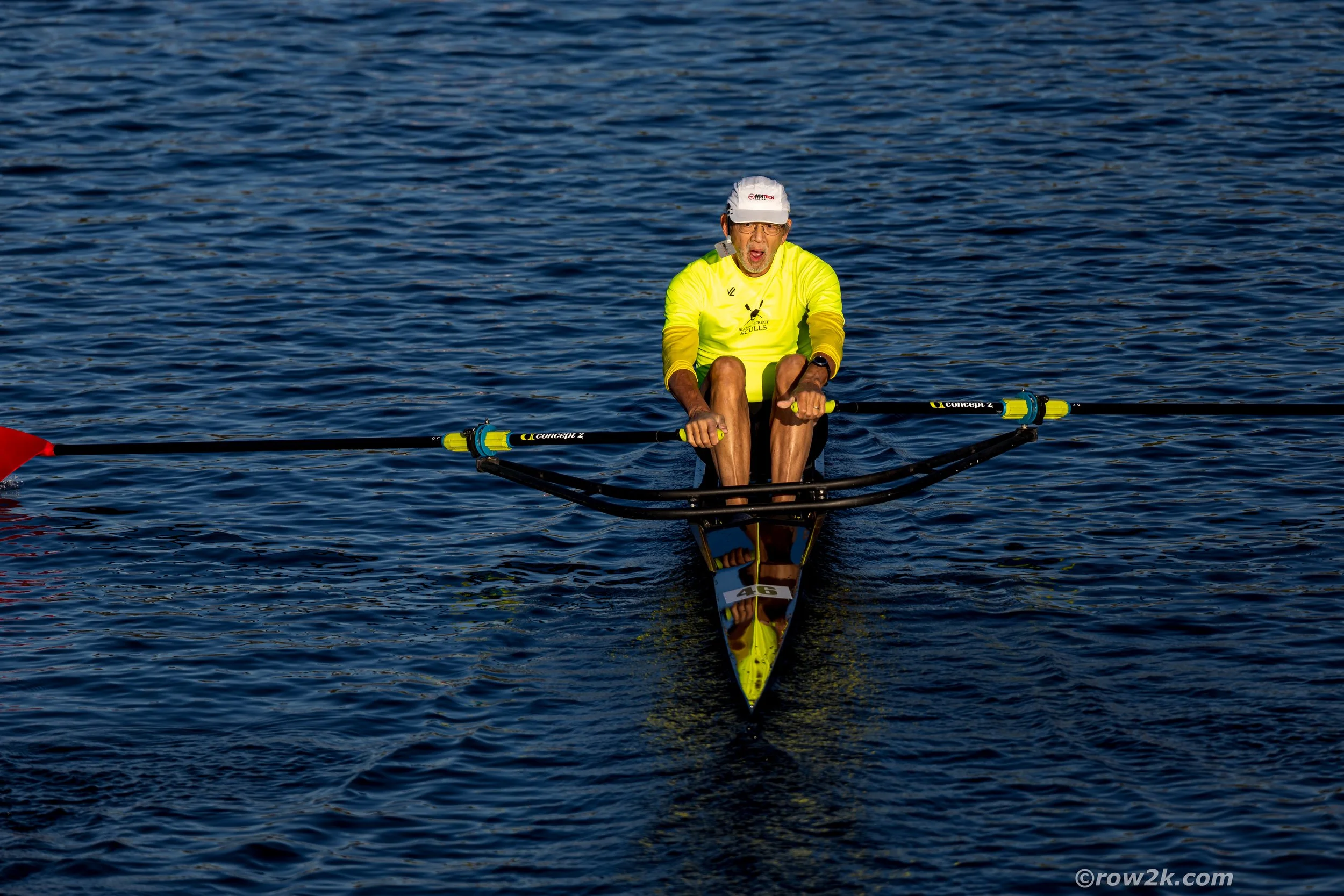
In 1965, at just 16 years old, Leeland “Lee” Cole-Chu competed in the first-ever Head of the Charles (HOCR). It was the same year CRWA was founded, and the same year The Standells released their iconic song “Dirty Water” about the polluted Charles River. Now, 61 years later, Lee returns to the Charles to compete in the world’s largest three-day regatta.
For the last three years, Lee has competed as a charity rower for HOCR, raising funds to support Charles River Watershed Association. We sat down with Lee ahead of the 2026 HOCR to learn more about his lifetime of rowing.
Interviewer: Hi Lee, thanks for being here. Could you please tell a bit about yourself and how you got into rowing?
Lee: My name is Lee Cole-Chu. I am a retired Superior Court judge in Connecticut. I started rowing in 1963 at the Choate School, and I rowed at Harvard. I was in the very first Head of the Charles in the lightweight junior singles in 1965 and won my event. I took about 35 or 40 years off of rowing before returning. 2023 was my first revisiting of the Head of the Charles, and I just love it. I love the sport. I love the exposure to beautiful waters and the Fall leaves now in this season. And I truly love the Head of the Charles institution and the camaraderie.
The Head of the Charles was so popular that, for most of the events, you have to put your name into a lottery. And the couple times I did that, I was 11th and 15th on the waiting list. So since I was serious about wanting to row in the Head again, I went to the charity program, and I was hooked up with Charles River Watershed Association.
And, to my multi-year delight, I tell friends that I buy my way in. But I do this with great joy: it's a pleasure to raise money for CRWA. I am in what I, with great respect, call the geezer singles. The men's 70-plus singles.
I have, every year I rowed, been beaten by 80-year-olds. I'm now 77 myself. But nobody's going to have a better time rowing these three miles. Whatever the conditions are, it's a joy to do it. And it's very satisfying to have some small role in fundraising for CRWA.
Interviewer: What made you want to come back to rowing after such a long break?
Lee: My late prep school rowing coach gave me his boat. It's a nice racing single and that inspired me. I thought, ‘I better do something with this’, both because it's a nice boat and because it's from my friend and my boyhood rowing coach.
Interviewer: The energy of the Head of the Charles is so special. From my perspective, it’s a unique event and a great source of pride for the city. Does it feel different from other regattas?
Lee: Oh, the sport is high energy, and the camaraderie is high energy. A late friend of mine, Tom Weil, a historian of the sport of rowing, said that most sports are games. Rowing is work. Its origins are in work: Transportation. Even War. And rowing is work.
And the top crews, particularly when there's more than one of you (you know, singles, it’s one thing; it’s independent), but if you do a pair or double or 4 or 8 with a cox, you've got to all show up. There's a camaraderie and a discipline to it. And then, of course, there's the work of rowing and the technique.
Interviewer: What's your favorite part of rowing? I know you mentioned you like being on the water, the camaraderie.
Lee: In my event, which is men 70 and older, there are typically several former Olympians, so it's challenging. It's really good for my health, for any participant's health. You sometimes have lousy conditions. In college, I remember, we would come back from a workout with our hair frozen. There’d be splash or rain; it would freeze, and there’d be ice on us, our oar locks, all over. It’s all a part of the adventure.
Interviewer: I’d like to hear a little bit about the first Head of the Charles. You were what, 16 or 17 years old? What do you remember from that day? I’m wondering if anyone had an idea of how big it would become?
Lee: I doubt they did! Of course, I doubt there's a bigger rowing city than Boston [Cambridge Metro area]. Philadelphia is, of course, grand. But yeah, who knew? My coach, the one who gave me my shell, and I've named my shell after him, Ben Sylvester, he went to Harvard, and I wouldn't have been in the race except for him.
That summer, my family happened to be in the process of moving from New Haven to New London, Connecticut. And we didn't have a house in New London yet. My dad was teaching at Thayer Academy in Braintree. And I took a course there. And then, kind of amazing in hindsight, my parents let me take a bus, then the T, to Charles Street station and Union Boat Club. Shout out to Union Boat Club (UBC). In the summer of 1965, they kindly let me, and I don't know whether I used a Choate boat or one of theirs, but they let me row out of UBC. And UBC staff and members kindly helped me prepare for my first Head in decades, in 2023.
I would arrive at Charles Street station, walk to UBC and row, I don't know, 4 or 5 days a week for that two-month summer. And I got to know the river; probably, you know, better than the other people in my ‘65 event. And it worked out great.
You know, I don't remember a thing really about the actual 1965 race. Or ‘66. I was also in [the Head of the Charles in] ‘66, though in a tougher division.
What I remember is that my coach told me I had won my event, and we went to the award ceremony. The award ceremony was in a fabulous building called 1010 Memorial Drive, right at that bend on the river, technically east of Cambridge Boat Club, in the penthouse. Which was still under construction, as I recall. Or the building was brand new. And I wasn't technically allowed in the event because I wasn't over 21. You know, alcohol was being served.
So anyway, that's what I remember well. Going all the way up to the top of 1010 Memorial Drive. I'd love to see that again. It was a very crowded room, and basically, I was a trespasser. Because of my age.
Well, you know what? I think this is true in life. If you're really in the moment, you often don't remember it. It's there, and then it's gone, and you move on. If you're lucky, you move on to the next thing in a conscious way.
Interviewer: You said it’s not your intention to win. Looking to the weekend, is there something that you're hoping to achieve or accomplish? Whether it’s a certain time you hope to finish under or just to enjoy it?
Lee: Well, you know, pushing yourself is really basic to lots of undertakings.
My goal would be to have my best time since I returned to sculling after 40 years, but that's not likely given my recent training program. And apparently the weather conditions for Friday are sketchy. We'll see, we'll see. But, you know, my goal is to do at least as well as I've done in the past three years and not to get in anybody's way as they pass me, if they do, and to have a blast.
My daughter, my youngest daughter, gave me a hat. She had it custom-made because it's a saying that I made up as a young dad, ‘Have a safe blast’. And she put this on my hat, and I'm going to put my little mirror on that hat and wear that as I go up the river.
Interviewer: Obviously, we are working hard to clean up the river. We’re removing defunct dams, we’re conducting water quality sampling to check on the health of the Charles, we’re advocating for an end to sewage dumping and working to strengthen regulations that would protect and improve the Charles. Why should people want a Clean Charles River?
Lee: Why not? I mean, the Charles [River] watershed is basically part of the geographic and geologic home for everybody in eastern Massachusetts.
Life is choices. We all make choices. Having a clean environment is important for everybody. Not just humans, of course, but all the aquatic species, birds, and the whole panoply of life with the capital L. And people ought to spend at least a little bit, contributing to its getting clean and staying clean.
And for CRWA to take a leadership role in bringing public attention to public policy decisions like that is very important.
Interviewer: Thank you for your time. We look forward to cheering you on this weekend!
Lee: And, well, if you weren't there, I wouldn't be able to row in the Head of Charles, so thank you.