
How clean is the Charles? Understanding the 2025 Charles River Report Card
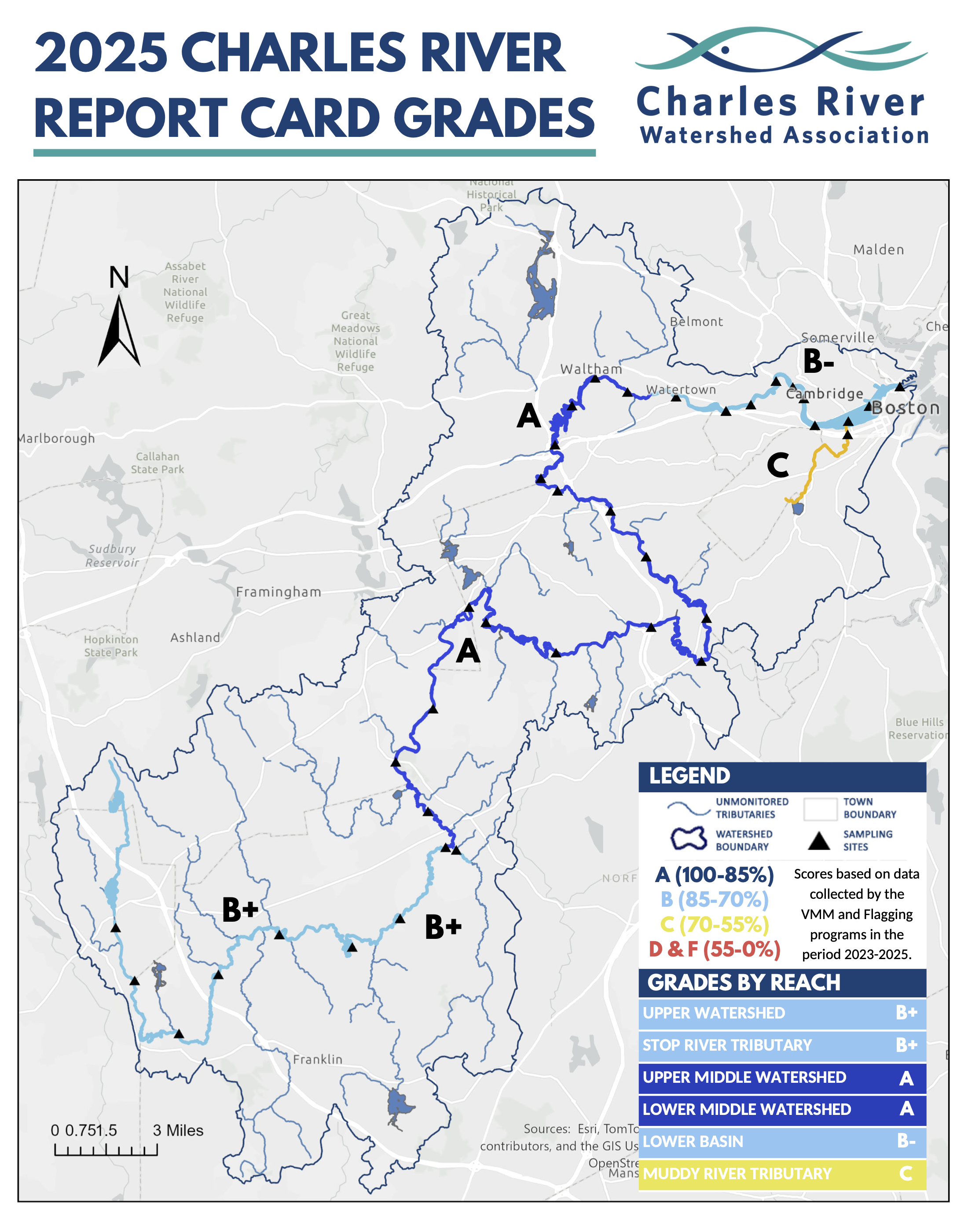
On May 6, 2026, CRWA joined the Mystic and Neponset River Watershed Associations and state and local leaders at the Boston Museum of Science to announce the 2025 Water Quality Report Card Grades for the three rivers that flow into Boston Harbor–the Charles, Mystic, and Neponset. Since 1995, U.S. EPA has issued the annual Charles River Report Card to report the recreational health of the Charles River. The 2025 Report Card Grades, which range from A to C, show that progress has largely stalled or declined slightly in the upper and upper middle watersheds, while the more urban parts of the Charles show slight, gradual improvements in water quality over time.
WHAT DO THE GRADES TELL US?
Based on our data collected by community science volunteers, the report card grades show the percentage of time public health hazards like E.Coli bacteria, sewer overflows, and cyanobacteria blooms impede safe recreation in four river sections and two tributaries, the Stop River and Muddy River.
In the Charles River, grades ranged from A’s in the middle watershed, B’s in the upper watershed and Lower Basin, to a C in the Muddy River, following trends observed across recent years. More developed, paved areas consistently see lower grades due to stormwater pollution, while greener areas with more forests and wetlands are safe for swimming on most days.
DEEP DIVE INTO THE GRADES
Two areas saw grades decrease slightly in 2025–the Lower Basin decreased from a B in 2024 to a B-, and the Muddy River tributary decreased from a C+ in 2024 to a C. The decrease in grade in the Lower Basin can be attributed mainly to the 2025 cyanobacteria bloom, while the decrease in the Muddy River is likely due to a combination of stormwater runoff and the known presence of illicit connections discharging into the tributary.
Two areas saw grades increase slightly in 2025 – the Upper Watershed increased from a B in 2024 to a B+ in 2025, and similar trends are seen in the Lower Middle Watershed. The Upper Middle Watershed and the Stop River tributary in Medfield maintained the same grades as last year.
CLIMATE CHANGE AND OUTDATED INFRASTRUCTURE STALL PROGRESS
Drought, heat, and increased precipitation from climate change make low water levels, toxic cyanobacteria blooms, CSOs, and stormwater pollution more frequent, inhibiting safe recreation. In Summer 2025, the Charles River Lower Basin experienced a cyanobacteria bloom that lasted for over 80 days! In both 2024 and 2025, severe drought caused several sections of the Charles River to run very low, with observed water levels under half a foot in Bellingham, Medway, and Newton. Additionally, in the past 3 years, due to ~130 inches of precipitation, 70 known CSO events discharged more than 136 million gallons of raw or treated sewage into the Charles.
“These grades make it clear that progress has stalled,” said Emily Norton, Executive Director of Charles River Watershed Association. “To achieve a truly clean, healthy, and swimmable Charles, we need to make the necessary investments in reducing stormwater runoff and ending sewage discharges. Let’s be the generation that finally finishes the job of delivering a clean Charles.”
IS IT SAFE TO SWIM IN THE CHARLES?
The short answer is… sometimes. And in wet weather, generally no.
Public health hazards, such as bacterial pollution from stormwater, sewer overflows, and toxic cyanobacteria blooms, continue to make swimming and boating unsafe in many sections of the Charles River.
WHAT ARE WE DOING ABOUT IT?
It’s not that we lack resources; it’s that we lack investment. From the Seine in Paris to the Chicago and Willamette Rivers here at home, cities worldwide are proving that urban waterways are worth the capital. Healthy, resilient rivers do more than just flow; they support public health, make our communities more resilient to flooding and climate change, and restore lost biodiversity. Clean water isn't just a resource for recreation—it’s an investment in our collective future.
We advocate for a clean, resilient, swimmable Charles River in all aspects of our work–one way is by building nature-based solutions, such as green infrastructure in cities and towns, to keep stormwater pollution out of the river and build climate resilience. Other options to eliminate CSOs include separating combined pipes or building underground storage to hold stormwater or combined sewage. However, a swimmable Charles River is only possible if decision-makers and the public support the necessary investments to make it a reality.
Join us in telling legislators that it’s time to ‘Cut the Crap.’ Click this link to send a message directly to your legislators asking for their support. With your help, we can put an end to combined sewer overflows and take a step towards a swimmable Charles River.